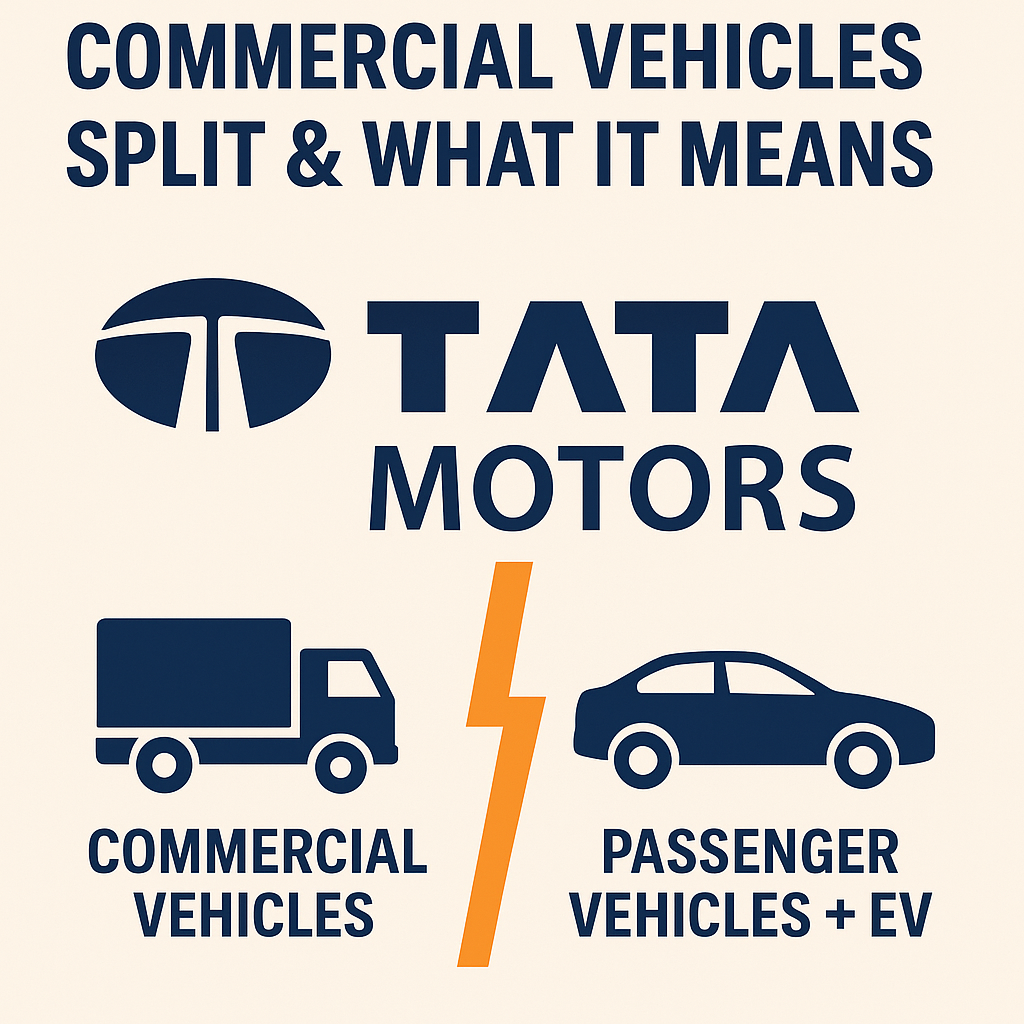
The Tata Motors demerger marks a significant corporate re-structuring for one of India’s largest automobile manufacturers. As of October 1, 2025 the formal business carve-out took effect, separating its Commercial Vehicle (CV) operations from its Passenger Vehicle (PV), Electric Vehicle (EV) and global luxury brand divisions like Jaguar Land Rover (JLR). The aim: sharper strategic focus, clearer valuations and enhanced shareholder value.
What is the Tata Motors Demerger?
The demerger essentially divides Tata Motors into two separate listed entities:
Commercial Vehicles (CV) business: Trucks, buses, defence vehicles, medium & heavy commercial vehicle operations.
Passenger Vehicles + EV + JLR business: Domestic passenger cars, electric vehicles, Jaguar Land Rover global business.
This split recognises that the CV and PV/EV businesses have very different demand cycles, capital needs, strategies and global positioning.
Key Details Tata Motors Demerger
Effective date: October 1, 2025 (legal effect of the scheme)
Record date for eligibility: October 14, 2025 — shareholders of Tata Motors as on this date are eligible.
Entitlement ratio: 1:1 — for every 1 share of Tata Motors, shareholder receives 1 share of the new CV entity.
Listing timeline: CV arm is expected to list by late November or early December 2025.
No cash outflow or share dilution: Shareholders continue to hold the same total number of shares; the split is structural.
Why is Tata Motors doing this Demerger?
The strategic rationale behind theTata Motors Demerger includes:
Focused strategy: Each entity can pursue its own growth path without being constrained by the other’s business model.
Capital allocation: CV and PV/EV businesses have different capital intensities and investor demands, so separating them allows tailored investment.
Clearer valuation: Markets often discount conglomerates; post-demerger, each business can be valued on its own merits, unlocking shareholder value.
Operational agility: With separate leadership and governance, each entity can make quicker decisions aligned to its segment.
Impact on Shareholders
The demerger is structured such that shareholders of Tata Motors are not losing value — they simply gain proportional exposure to both businesses. Key effects for shareholders include:
You will hold one share in the PV/EV & JLR entity plus one share in the CV entity for every share you had — effectively two listed securities. :contentReference[oaicite:12]{index=12}
There is no immediate cash transaction; the split is equity-based and non-dilutive.
Until the CV arm lists publicly, its shares may be frozen or non-tradeable while listing formalities complete.
Tax cost of acquisition, holding periods etc will be adjusted; your original purchase date and cost will typically carry over — consult your broker/tax advisor.
Market Reaction & Valuation Considerations
Analyst commentary suggests:
The CV arm is seen as a value-unlock opportunity given its dominance in the Indian commercial vehicle market and potential global expansion. :contentReference[oaicite:16]{index=16}
Initial implied value for the CV entity was around ₹260-₹270 per share based on pre-demerger stock splits; some brokers expect the listing to open in the ₹300+ range. :contentReference[oaicite:17]{index=17}
Short-term volatility is expected as the market digests the new structure, adjusts index weights, and fund flows realign. :contentReference[oaicite:18]{index=18}
Note: The demerger is a structural change and not a standalone business turnaround — long-term value hinges on execution, market demand cycles (especially in CV business), and global expansions.
Key Takeaways & Verdict
In summary:
The Tata Motors demerger is a significant strategic milestone, splitting a large conglomerate into two focused, listed entities.
Shareholders retain full ownership in both new companies under the 1:1 ratio — preserving value while gaining choice.
The CV entity, given its market leadership and scale, could attract investors seeking stable industrial/infra exposure, while the PV/EV+JLR business offers high-growth potential.
Execution risks remain: listing timelines, regulatory approvals, ease of separation of operations & balance sheets, global expansion (especially for CV business) will matter.
Verdict: For long-term investors, this demerger provides greater clarity and optionality. For those seeking short-term stock moves, volatility is likely until the CV listing settles and market perception forms.
Frequently Asked Questions (FAQ)
Q1: What happens if I sell my Tata Motors shares before the record date?
A1: Only shareholders holding Tata Motors shares as of the record date (October 14, 2025) are eligible to receive shares of the CV entity. :contentReference[oaicite:19]{index=19}
Q2: Will the CV entity have a new ticker symbol?
A2: Yes — the new CV company will list with its own ticker on BSE & NSE once listing approvals are complete. :contentReference[oaicite:20]{index=20}
Q3: Does this affect the business operations of the existing Tata Motors brands like JLR?
A3: No immediate change in brand operations; JLR remains under the passenger vehicles/EV entity. The demerger is structural, not a brand sale. :contentReference[oaicite:21]{index=21}
Q4: Will there be any change in dividend policy or share buy-backs?
A4: Potentially yes — each entity now has independent board and capital policy, so dividend/buy-back decisions may vary in future. Investors should monitor corporate actions for each entity separately.
© tech.songlirics • Updated: November 2025





 WhatsApp
 X
X Telegram
 Instagram
 Arattai