Tata Motors Commercial Vehicles Demerger: Full Details, Impact & Future Plans
Updated on February 28, 2026 – This article includes the latest data and pricing.
Tata Motors Commercial Vehicles Demerger: Full Details, Impact & Future Plans

Summary: Tata Motors, one of India’s most trusted automobile giants, has officially announced its plan to demerge its commercial vehicles business into a separate listed entity. This strategic decision marks a major transformation in the company’s structure, aligning with its long-term growth strategy, EV expansion, and investor value creation.
In this detailed analysis, we’ll explore everything you need to know about the Tata Motors Commercial Vehicles Demerger — the reasons behind it, its potential benefits, its impact on shareholders, and what the future holds for India’s largest commercial vehicle manufacturer.
What is the Tata Motors Commercial Vehicles Demerger?
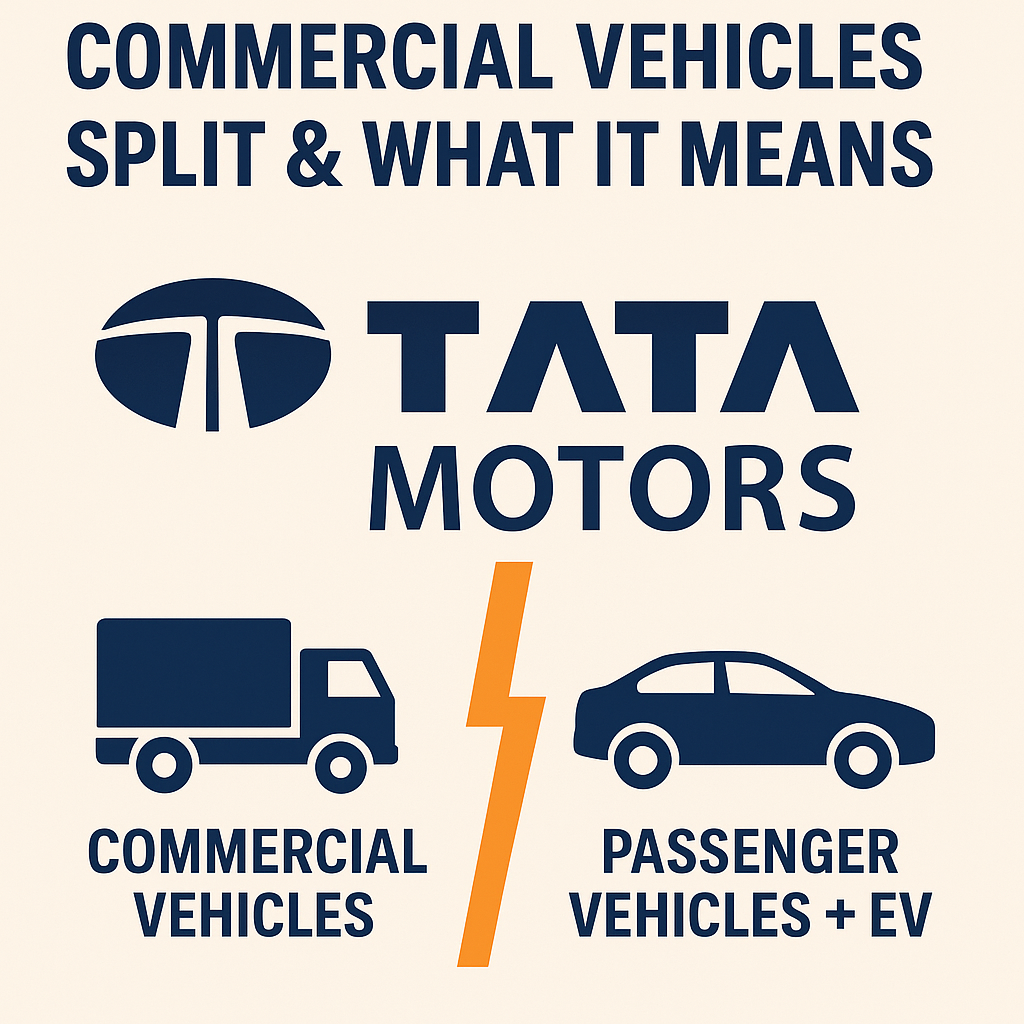
The Tata Motors Commercial Vehicles Demerger refers to the separation of Tata Motors’ commercial vehicle (CV) business from its passenger vehicle (PV) and electric vehicle (EV) divisions. This means Tata Motors will operate as two distinct listed entities:
- Tata Motors Commercial Vehicles Ltd. – focusing on trucks, buses, and fleet services.
- Tata Passenger Vehicles Ltd. – handling passenger cars and electric mobility.
This move follows the earlier internal restructuring done by Tata Motors in 2022 when the company created separate verticals for its PV and CV businesses for operational clarity. The demerger is the next logical step to unlock value and bring sharper business focus.
Why Did Tata Motors Decide to Demerge Its Commercial Vehicles Division?
There are multiple strategic reasons behind the Tata Motors Commercial Vehicles Demerger. The Indian auto market is evolving rapidly, and each segment — passenger, electric, and commercial — requires distinct strategies. Here are the key factors:
1. Focused Growth Strategy
The commercial vehicle business has unique market dynamics, customer profiles, and global competition. By creating an independent entity, Tata Motors can ensure dedicated management focus and tailored investments for its CV segment.
2. Unlocking Shareholder Value
Investors often value diversified businesses differently. Through the demerger, Tata Motors aims to unlock hidden value for shareholders by giving them direct ownership in both entities — CV and PV/EV.
3. Electric Vehicle Transition
While the passenger segment is rapidly adopting EVs, commercial vehicles have different technology needs. Separate operations will allow Tata Motors CV to invest specifically in electric trucks and clean-fuel technologies like hydrogen fuel cells.
4. Operational Independence and Efficiency
Independent governance will enable faster decision-making, flexible partnerships, and better capital allocation across both entities. This agility is vital for competing with global players like Ashok Leyland, Volvo Eicher, and Mahindra.
How Will the Demerger Work?
The Tata Motors Commercial Vehicles Demerger will be executed through a court-approved scheme of arrangement. Here’s a simplified breakdown:
- Tata Motors shareholders will receive shares in both the new CV entity and the PV/EV entity in the same proportion.
- The two companies will remain under the Tata Group umbrella but will operate with independent boards and management teams.
- All assets, liabilities, and employees related to the CV business will be transferred to Tata Motors Commercial Vehicles Ltd.
Post demerger, both companies will continue to trade on the NSE and BSE, ensuring transparency and liquidity for investors.
Impact on Shareholders and Investors
The Tata Motors Commercial Vehicles Demerger is expected to have significant implications for investors. Let’s analyze the key points:
1. Value Creation
Historically, demergers in India — like those of Reliance Industries or Bajaj Auto — have unlocked shareholder value. Similarly, analysts expect the Tata Motors split to enhance the market valuation of both entities.
2. Increased Transparency
With clearer financial reporting for each business, investors can better assess performance, profitability, and growth potential.
3. Improved Strategic Partnerships
Independent entities can attract new investors, joint ventures, and technology partnerships specific to their business focus areas.
4. Possible Re-Rating of Shares
Market experts predict that both Tata Motors PV and CV units could get separate valuations — with the CV business likely to be valued at 6–8x EBITDA, considering its dominant market share in India.
Performance of Tata Motors’ Commercial Vehicle Segment
Tata Motors is India’s largest commercial vehicle manufacturer, commanding over 40% market share. Its CV portfolio includes:
- Small Commercial Vehicles (SCV): Ace, Intra
- Medium & Heavy Commercial Vehicles (MHCV): Prima, Signa, Ultra
- Buses: Starbus, Magna, Winger
In FY2024, Tata Motors CV business reported:
- Revenue: ₹70,000 crore+
- EBIT Margin: ~8%
- Exports: to 50+ countries
The demerger will enable more focused R&D spending on electric trucks, hydrogen mobility, and connected vehicle technologies.
Tata Motors Demerger Timeline
Here’s a quick look at the expected timeline for the Tata Motors Commercial Vehicles Demerger:
- 📅 March 2024: Demerger announcement
- 📅 Mid-2025: Regulatory and shareholder approvals
- 📅 Late 2025: Listing of the new CV entity on stock exchanges
Market Reaction and Analyst Views
Following the demerger announcement, Tata Motors’ stock surged by over 4% on the NSE. Analysts from major brokerages such as Motilal Oswal and ICICI Securities have termed it a “value-unlocking” move.
According to analysts, the CV business, once independently listed, could become a magnet for ESG investors and global funds focusing on green logistics and sustainability.
Comparing Tata Motors’ Strategy with Global Peers
Globally, major automakers have undergone similar restructuring. For example:
- Volvo Group separates its truck and car businesses for focus.
- Ford created dedicated EV and traditional vehicle units.
- Mercedes-Benz spun off Daimler Truck to unlock value.
Tata Motors’ demerger follows a similar playbook — focusing on clarity, innovation, and long-term sustainability.
What It Means for Employees and Dealers
Tata Motors has assured that the demerger will not impact jobs or existing dealer relationships. All employees working in the CV division will move to the new company without any loss of benefits or tenure.
The company also plans to invest more in digital transformation, dealer digitization, and customer experience in the CV segment post demerger.
Key Benefits of Tata Motors Commercial Vehicles Demerger
- 🎯 Focused leadership on CV and PV growth independently.
- 💰 Better capital allocation for each business.
- 🌱 Accelerated green mobility initiatives for commercial vehicles.
- 📈 Value unlocking potential for shareholders.
- 🤝 Stronger global partnerships and collaborations.
Challenges Ahead
Despite the positives, challenges remain. The CV industry is cyclical, dependent on infrastructure spending and economic conditions. Tata Motors must ensure strong cost control, supply chain efficiency, and consistent innovation to maintain market leadership post demerger.
Risk Factors
- Volatility in diesel prices
- Competition from Ashok Leyland, BharatBenz, and Eicher
- High R&D costs for electric commercial vehicles
Future Outlook: What’s Next for Tata Motors?
Post demerger, Tata Motors will have two independently strong businesses. The CV arm will focus on fleet electrification, alternative fuels, and connected technologies, while the PV division will push aggressively into electric mobility and exports.

Experts believe this move could position Tata Motors as a future-ready automotive powerhouse both in India and globally.
Conclusion
The Tata Motors Commercial Vehicles Demerger marks a new chapter in the company’s legacy. With a sharper strategic focus, improved investor transparency, and a clear path toward sustainable mobility, this move could redefine India’s automotive landscape. For long-term investors, it’s a development worth watching closely.
FAQs About Tata Motors Commercial Vehicles Demerger
1. What is the purpose of the Tata Motors demerger?
The goal is to create focused, independent entities for passenger and commercial vehicles to unlock value and accelerate growth.
2. Will shareholders get new shares after the demerger?
Yes, existing shareholders will receive shares in both the new CV and PV entities in the same proportion as their current holdings.
3. How will this affect Tata Motors’ stock price?
Analysts expect a positive re-rating in the long term as both businesses get independent valuations.
4. Is the demerger expected to impact employees?
No, all employees and dealer networks will continue under their respective divisions with full continuity.
5. When will the demerger be completed?
The process is expected to complete by late 2025 after regulatory and shareholder approvals.
Read related business updates on NDTV Business
Read more Auto Industry News on our website
About the author
Tech Song Lirics
Tech Songlirics delivers the latest tech news, smartphone reviews, and gadget updates in India — simplified, reliable, and made for tech lovers who want real insights, not just specs.





 WhatsApp
 X
X Telegram
 Instagram
 Arattai